
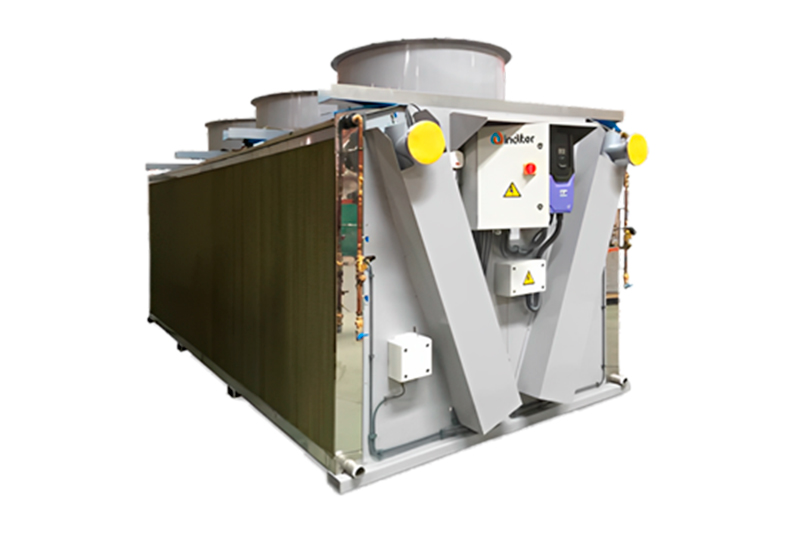
Today, energy efficiency and sustainability are more important than ever, which is why understanding the principles behind adiabatic cooling has become essential.
This process, based on the expansion of a gas without heat exchange with the environment, offers an innovative solution for temperature control in various industrial and commercial applications.
At Inditer, we offer the highest quality in industrial climate control services, and in this post, we will explain in detail how the adiabatic cooling process works, the physical fundamentals that support it, and its relevance in optimizing refrigeration systems.
Read on to learn how this technique not only improves efficiency but also contributes to a more sustainable future.
What is adiabatic cooling?
Adiabatic cooling is a fundamental thermodynamic process that consists of reducing the temperature of a gaseous fluid or air without heat exchange with the environment. This occurs when a gas expands, causing a decrease in its internal energy and, therefore, a reduction in its temperature.
This procedure is used in various applications, especially in HVAC and refrigeration systems. It should be noted that it is also a phenomenon that can be observed in nature, such as in the formation of clouds when warm air rises and cools as it expands.
Types of adiabatic cooling
There are two main types of adiabatic cooling in HVAC:
- Direct adiabatic cooling: In this method, hot air is passed directly through sprayed water or an adiabatic panel. Small water particles absorb heat from the air, causing it to cool. This system is most effective in dry environments where relative humidity is low, as it allows for a greater cooling capacity.
- Indirect adiabatic cooling: This process involves the use of a heat exchanger. Here, the exhaust air is cooled before passing through the exchanger via spraying or an adiabatic panel, allowing the supply air to reduce its temperature and cool down without direct contact with water. This method is useful in dual-flow systems and is ideal for maintaining more precise humidity control.
How does adiabatic cooling work?
- Water evaporates: By bringing water into contact with hot, dry air (in the form of vapor or small droplets), part of this water evaporates.
- Evaporation consumes energy: To change from a liquid to a gaseous state, water molecules need energy. They take this energy from the surrounding air.
- The air cools: By losing energy, the air cools down. It is as if the water takes the heat from the air in order to evaporate.
Advantages of adiabatic cooling
Adiabatic cooling offers several advantages:
- Energy efficiency: It requires less energy compared to conventional refrigeration systems that use compressors.
- Simplicity of installation: It does not require complex components, which reduces installation and maintenance costs.
- Sustainability: By using water for cooling, a significant reduction in energy and water consumption can be achieved compared to other systems. It does not use refrigerant gases that damage the ozone layer.
- Improved comfort: This method not only reduces the temperature but also increases relative humidity, which can improve the thermal sensation in dry environments.
Applications of adiabatic cooling
Adiabatic cooling is a process used in a variety of settings, from industrial facilities to HVAC systems in commercial buildings. It is especially effective in hot, dry climates, where it can provide significant heat relief without high energy consumption:
1. Building climate control
This process is used in HVAC systems to cool the air introduced into indoor spaces. This can be done through direct adiabatic cooling, where hot air is cooled as it passes through sprayed water, or through indirect adiabatic cooling, which uses heat exchangers to cool the air without direct contact with water.
2. Industrial refrigeration
In industrial environments, adiabatic cooling is applied to maintain optimal temperatures in production processes. For example, it is used in closed-circuit water cooling systems, where ambient air is cooled as it crosses with sprayed water particles, allowing its temperature to be reduced before passing through the exchanger for efficient cooling of equipment and machinery.
3. Humidity increase in processes
In addition to cooling, this cooling method is also used to increase humidity in facilities where necessary, such as in storage processes for products that require a humid environment to prevent drying out.
4. Ventilation systems
Ventilation systems incorporating adiabatic cooling are common in large spaces, such as train stations or commercial buildings, to cool indoor air by spraying water in vegetated areas, thus improving thermal comfort.
5. Energy efficiency and sustainability
It is a sustainable option that allows for significant water and energy savings compared to traditional refrigeration systems, making it an attractive solution for companies looking to reduce their environmental footprint and operational costs.
What is an adiabatic dry cooler?
An adiabatic dry cooler is a piece of equipment that uses the principle of evaporative cooling to condition air; that is, it takes advantage of water’s ability to absorb heat as it evaporates to reduce the air temperature.
How does it work?
- Hot and dry air intake: Hot ambient air enters the equipment.
- Contact with water: The air passes through a porous medium (such as cellulose panels) soaked in water or through spray nozzles.
- Water evaporation: Part of the water evaporates by absorbing heat from the air.
- Air cooling: By losing heat, the air cools down and becomes slightly saturated with moisture.
- Cold and humid air outlet: The cooler, more humid air is expelled from the equipment.
What is an adiabatic condenser?
An adiabatic condenser is a type of cooling equipment that uses the principle of evaporative cooling to reduce the temperature of a fluid, generally a refrigerant.
Unlike traditional condensers that use water directly to cool the coil, adiabatic condensers use air as the cooling medium, but pre-condition it to improve its heat absorption capacity.
Conclusion
Adiabatic cooling is an innovative and efficient solution for temperature control in various applications. Understanding how it works and its benefits can help optimize HVAC and refrigeration systems, contributing to a more sustainable use of energy resources.