
There are several types of heat exchangers, each adapted to different needs and operating conditions. These include plate and tubular heat exchangers.
At Inditer, we can tell you that each type has its own characteristics, advantages, and applications, making the choice of the right exchanger essential for the success of any project.
That being said, throughout this post, we will explain in detail everything about the different types of heat exchangers, their operating principles, and the most common applications.
Discover how these devices contribute to energy efficiency and optimal performance in various industries.
What are heat exchangers?
Heat exchangers are essential components in a wide variety of industrial processes and HVAC systems. Their primary function is to transfer heat between fluids, which optimizes energy efficiency and improves the performance of thermal systems.
From machinery cooling to the heating or cooling of process fluids, heat exchangers play a crucial role in thermal management.
Main types of heat exchangers and their advantages
Below, we present the two main types of heat exchangers available:
1) Heat exchanger
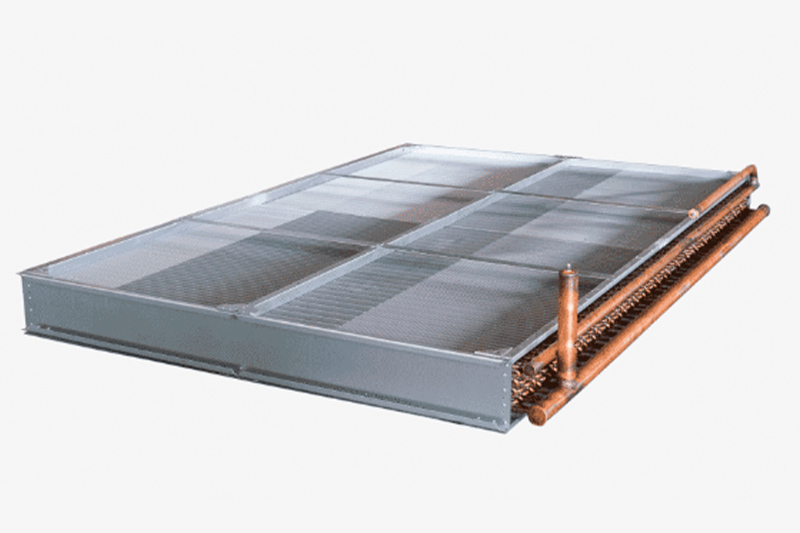
INDITER heat exchangers are composed of multiple corrugated metal sheets, arranged alternately to allow the flow of two different fluids without mixing. The geometry of the plates and flow channels are carefully designed to maximize heat transfer and minimize pressure losses.
Advantages of plate heat exchangers
INDITER plate heat exchangers offer a series of advantages that make them ideal for various industrial applications:
- High thermal efficiency: Thanks to their compact design and large exchange surface area, they are among the types of heat exchangers that allow for more efficient thermal transfer compared to other types, resulting in better energy performance and lower operating costs.
- Design flexibility: These exchangers are modular, meaning they can be easily adapted to different capacity and space needs, allowing companies to customize their systems according to their specific requirements.
- Easy maintenance: The fin structure allows for easy access for cleaning and maintenance, a relevant aspect in industries where hygiene is crucial, such as the food and pharmaceutical sectors.
- Reduced space requirements: Due to their compact design, these heat exchangers occupy less space than tubular exchangers, which is an advantage in installations where space is limited.
- Corrosion resistance: The materials used in the manufacture of the fins, such as stainless steel, offer high resistance to corrosion, which extends the equipment’s service life and reduces the need for frequent replacements.
- Versatility of applications: They are suitable for a wide range of applications, from heating and cooling systems to complex industrial processes, making them a versatile option for different sectors.
Selecting the Right Exchanger
Knowing the different types of heat exchangers makes the right selection easier, though a detailed evaluation of the specific application requirements will be necessary.
Factors to consider include:
- The fluids involved: their properties, temperature, pressure, viscosity, etc.
- Fluid temperature: The temperature difference between the fluids affects the heat transfer rate.
- Fluid flow rate: The amount of fluid that must pass through the exchanger.
- Fluid pressure: The pressure of the fluids affects the selection of construction materials.
- Fluid viscosity: The viscosity of the fluids affects the pressure drop and the efficiency of the exchanger.
- Fluid corrosivity: Construction materials must be compatible with the fluids.
- The required heat transfer rate: the amount of heat to be transferred per unit of time.
- Operating conditions: pressure, temperature, environmental corrosivity, etc.
- Header: The space available to install the exchanger, as well as the size and shape of the exchanger.
- Cost: The initial and operating cost of the exchanger.
Whatever the choice, the different types of INDITER heat exchangers represent a reliable and efficient solution for heat transfer in various industrial applications, offering durability and superior performance.